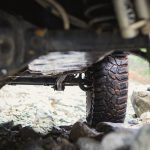
The car’s shocks and struts absorb road imperfections such as potholes and uneven pavement. Additionally, they stabilize your car during turns, braking, and acceleration. Some cars utilize struts instead of shocks, while others use a combination of the two.
In addition to the replacement cost, this post will also clarify the difference.
Let’s begin with the fundamentals and make sure you comprehend the situation!

Know the difference between shocks and struts
These terms are frequently used interchangeably. This is because they do the same function but are not identical components. You cannot replace malfunctioning shocks with struts or vice versa.
Some cars utilize shocks on one axle and struts on the other. The primary distinction between struts and shock absorbers is that struts are integrated into the suspension system, whereas shock absorbers are not. This indicates that struts have more roles than shocks.
In addition to decreasing bounce and roll, and stabilizing the car, as do shock absorbers, struts offer structural support for the suspension and maintain the correct tire alignment.
The camber and caster angles are modified during a wheel alignment by directly modifying the struts. This also means that strut replacement typically requires a wheel alignment, whereas shock replacement does not.

When to replace shocks and struts?
Now that you understand what they are and how they differ from each other, you must determine when each should be changed. There are a few indications that your shocks and struts require replacement. The indicators may include:
Tilting Car
If you observe that your car is leaning to one side or the other, it may be an indication of faulty duo. You may also observe the car swaying back and forth when the weather is windy.
Uneven Wear of Tires
If your car’s shock absorbers and struts are not functioning properly, the wheels may jiggle, resulting in inconsistent tire-to-road contact. As a result, the tire will experience uneven wear.
Due to increased wear, the tires may also be susceptible to scalloping/cupping, which are regions of high and low spots.
Shakes and Rattles
Your car’s suspension, struts, or shocks may malfunction if you see shakiness even on flat terrain. Additionally, steering wheel vibrations may indicate worn shocks and struts, especially if they occur on a smooth surface.
Check if the car swerves while braking
A significant warning sign is swerving during braking. Typically, the car’s front end would dip considerably when this occurs. If this occurs, it is imperative to address the issue as soon as possible, as applying the brakes unexpectedly could have disastrous results.
This issue is especially hazardous when it is damp. Generally, it also takes longer to stop the car, but this cannot be easy to observe because the difference is subtle.

Ways to check shock absorbers
If you believe your shocks are damaged or want to inspect them, you can do it easily. First, push the front of your car up and down, then stop quickly to test the shocks. If the car’s shocks are in good condition, it will stop moving.
If the car continues to move up and down, the shocks are likely worn out and require replacement. There are several methods for testing shock absorbers. Remember that this test only applies to shock absorbers and not to struts.
Ways to check struts
Because the placement and function of struts differ from those of shock absorbers, the test for shock absorbers cannot be applied to them. The only way to evaluate the struts is to do a road test and observe any indicators of deterioration, such as vibrations, rattles, or nosedives.
Ensure that you test the car in a safe place while abiding by all local traffic laws.
What does the shocks and struts replacement cost?
Typically, they are reliable for 50,000 to 100,000 miles, although these values are estimations, and the actual mileage may be greater or less.
Replacing both on the same axle is advised.
As shock absorbers do not affect steering, camber, or caster angle, they are easier and less expensive to replace than struts and typically do not necessitate a wheel alignment.
Parts expenses to replace the shocks on the same axle will average between $250 and $600, while labor costs will range between $150 and $350. When it comes to struts, they are significantly more costly. The overall cost to replace a pair of struts, including wheel alignment, is between $400 and $1,000 on average.
An individual strut assembly costs between $150 and $350, while labor for a pair costs between $100 and $300.
You can choose to replace merely the struts (rather than the strut assembly) to save between $40 and $80. However, replacing struts is more cost-effective and yields superior outcomes than replacing the entire strut assembly.
Bottomline
Shock absorbers and struts ensure that your car drives smoothly by absorbing the shocks caused by potholes and uneven pavement. Although many individuals use the terms shocks and struts interchangeably, it is crucial to note that their costs and functions are distinct.
In addition to serving the same function as shocks, struts also aid in steering and offer structural support for the suspension. Strut replacement typically necessitates a wheel alignment, whereas shock replacement does not. If your car begins to vibrate, swerve while braking, or lean in the wind, your shocks or struts may require replacement and should be inspected.
You can perform a simple test for shocks by pushing up and down on the front or rear of the car; if the car continues to “bounce” after you let go, the shocks are likely defective.
The only way to inspect your struts is via a road test in a controlled setting.
Here’s more info on top-rated airport parking, the best parking spots in your city, affordable auto insurance, easy auto refinance, and high-quality car washes near you.
Get 10% off in the Way App in the Way App!

- Scan and get the Way App Download the Way App
- Log in to your account
- Use code FIRST10 at checkout